
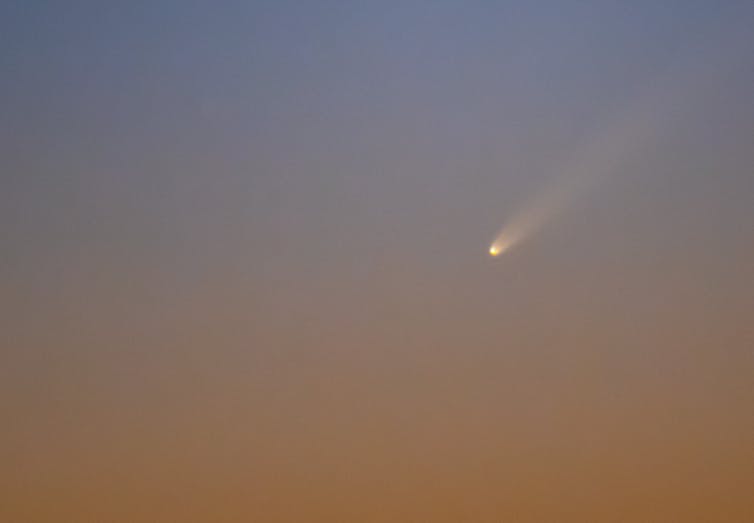
James Wray, Georgia Institute of Technology
A giant, icy cloud called the Oort Cloud surrounds our solar system. It’s mostly invisible but may hold billions of comets. Two such comets, Tsuchinshan-ATLAS and C/2024 S1 (ATLAS), are visiting us this Halloween!
- Tsuchinshan-ATLAS: This comet will be visible to the naked eye for a few weeks after October 12th. Look west shortly after sunset.
- C/2024 S1 (ATLAS): This comet might be visible around the end of October, low in the eastern sky before sunrise. It may reappear in the west around Halloween.
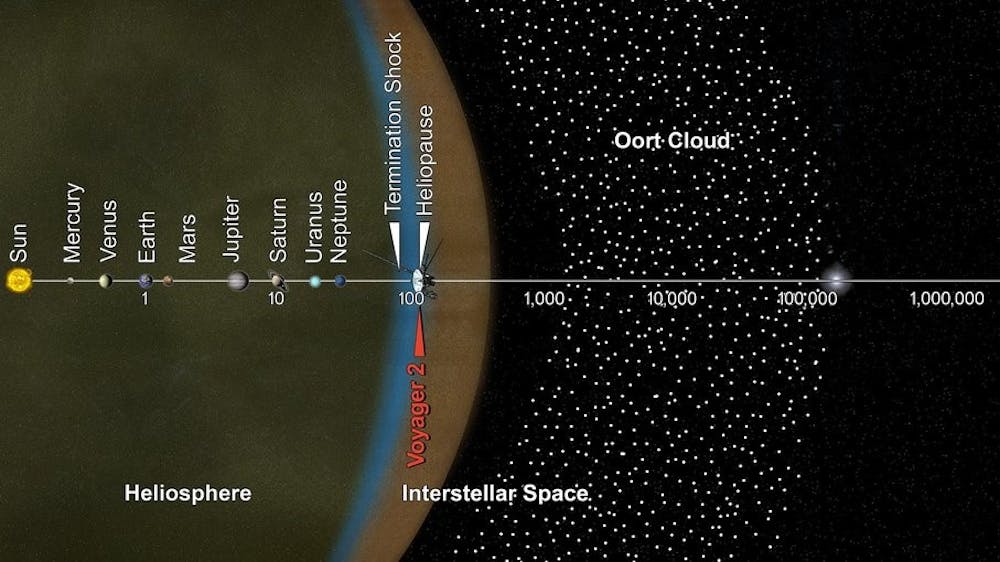
The Oort Cloud: A spooky source of life and danger
The Oort Cloud is a vast reservoir of icy bodies that may have delivered water to Earth, but some could also potentially collide with our planet. These long-period comets travel millions of years between visits to the inner solar system.
Long-period comets present a particular potential danger to Earth. Because they are so far from our Sun, their orbits are readily altered by the gravity of other stars. That means scientists have no idea when or where one will appear, until it does, suddenly. By then, it’s typically closer than Jupiter and moving rapidly, at tens of thousands of miles per hour. Indeed, the fictional comet that doomed Earth in the film “Don’t Look Up” came from the Oort Cloud.
New telescopes are helping us discover more Oort Cloud comets, with the number expected to double soon.
Looking up is safe (for now):
These Halloween comets pose no threat. They’ll pass millions of miles away from Earth.
The future of Oort Cloud exploration:
Scientists are planning missions to study these ancient objects and learn more about the solar system’s origins.
This article is a short version of an article from The Conversation under a Creative Commons license. Read the original article by James Wray, Professor of Earth and Atmospheric Sciences, Georgia Institute of Technology.
 Twice Mag